
Bridgeport County Court Records After a Jail Arrest
An arrest in Bridgeport County rarely ends at the jail door. Police book the person, and the matter then moves toward the courts. In Connecticut, the prosecutor is a State's Attorney, not a district attorney. The Office of the State's Attorney, Judicial District of Bridgeport, reviews the case and files the charges. Those filed charges open a court case, and that case is the court record people search after an arrest. State law requires that an arrested person be presented before a judge with reasonable promptness, so a case can appear quickly. The court record holds the formal charges, the docket, the court dates, and the final outcome.
The booking side and the court side answer different questions. Custody status, the booking entry, and where someone is held sit on the jail roster. For that, see the jail inmate records page, and for booking photos see the jail roster mugshots page. The court record is the charge sheet the State's Attorney filed and the activity that follows it. Booking charges listed at arrest can differ from the charges the prosecutor finally files. That is why the court record, not the arrest entry, is the reliable source for what someone is actually charged with.
The Bridgeport Judicial District serves six towns. Those are Bridgeport, Easton, Fairfield, Monroe, Stratford, and Trumbull. A case from any of these towns may land in a Bridgeport court.
How to Find Bridgeport County Court Records After an Arrest
The Connecticut Judicial Branch runs the public case-search tools where charges and charge status show up. The main hub is the Criminal/Motor Vehicle Case Look-up. It groups searches by type. You can look up a Pending Case by defendant or docket number, Convictions by defendant or docket number, the Daily Docket by court or defendant, Arrest Warrants, and Motions to Seal or Close. Each path reaches a different slice of the record. The arrest and booking detail itself stays on the jail roster, while the filed charges live in these court tools.
Most readers start with the pending-case search and a name. The basic flow is short.
- Open the Criminal/Motor Vehicle Case Look-up and choose a category, such as Pending Case by defendant.
- Search by the defendant's last name, or enter the docket number if a summons, bond receipt, or court notice gives one.
- Open the matching case and read the charge list the State's Attorney filed.
- Check each charge's statute, level, and current status, then note the next court date.
To picture the entry point, the Criminal/Motor Vehicle Case Look-up page opens the public lookup categories for Bridgeport cases.
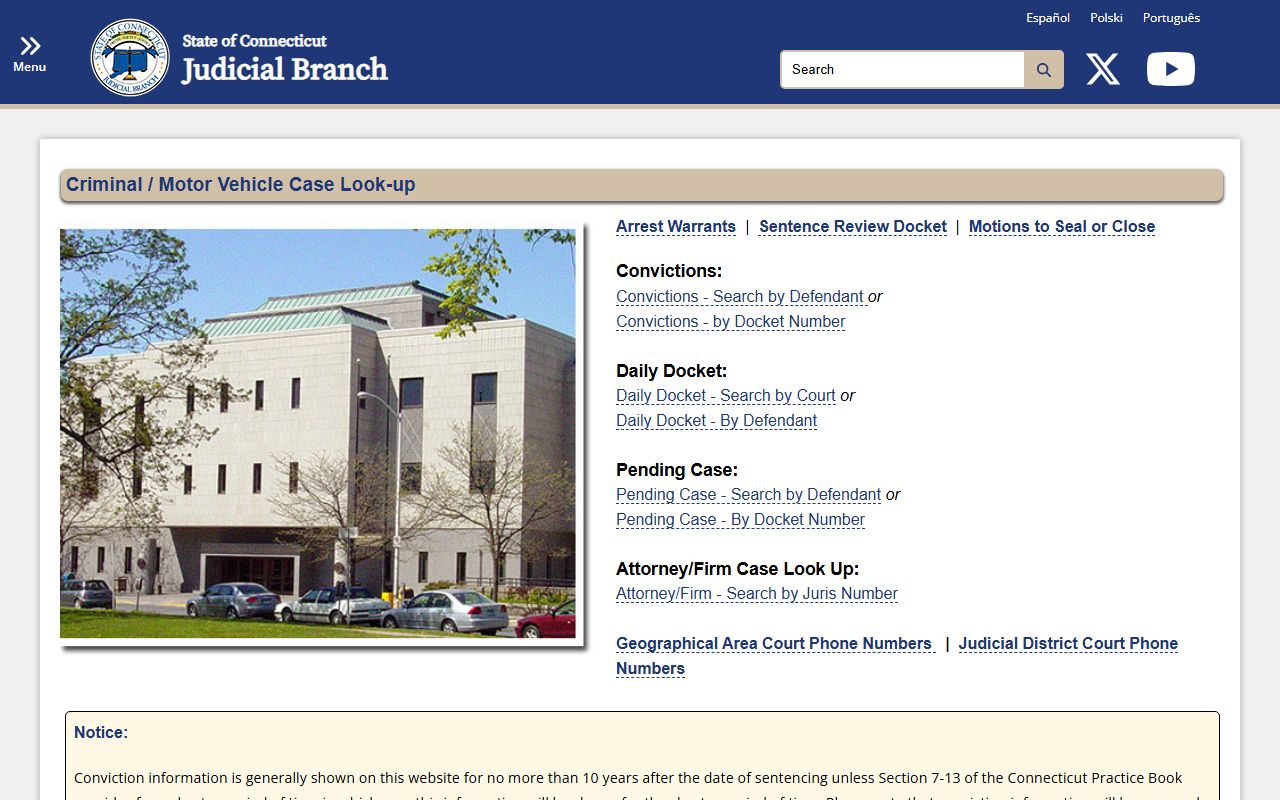
That landing page is the doorway to nearly every public court search after an arrest. From there, the defendant and docket paths split into pending cases, convictions, and daily dockets. A statewide point to remember is that the conviction search is not a full criminal-history check. The Judicial Branch limits online conviction display, leaves out youthful-offender and juvenile cases, and warns the data can change daily due to erasures, corrections, and pardons.
Search Pending Bridgeport County Court Records by Defendant
The pending-case search is the first public path for an open case that has been entered and stays public. It runs on a name, with a few fields that narrow the result. The required field is the last name, entered as a "begins with" match. The rest help when a name is common. A court-location dropdown lets you point the search at a Bridgeport court code, and a category dropdown picks criminal or motor vehicle.
| Field | Required | Notes |
|---|---|---|
| Last Name (begins with) | Yes | Main search field; matches names that start with the text. |
| First Initial | No | Narrows a common last name. |
| Birth Year | No | Used together with the year range. |
| Year Range + or - | No | Widens or tightens the birth-year match. |
| Court Location | No | F02B Bridgeport GA 2, XBR Bridgeport Housing, FBT Bridgeport Judicial District. |
| CategoryType | No | Criminal or Motor Vehicle. |
| Search | N/A | Runs the lookup. |
The pending case search by defendant uses exactly these fields. A look at the search form makes the layout clear.
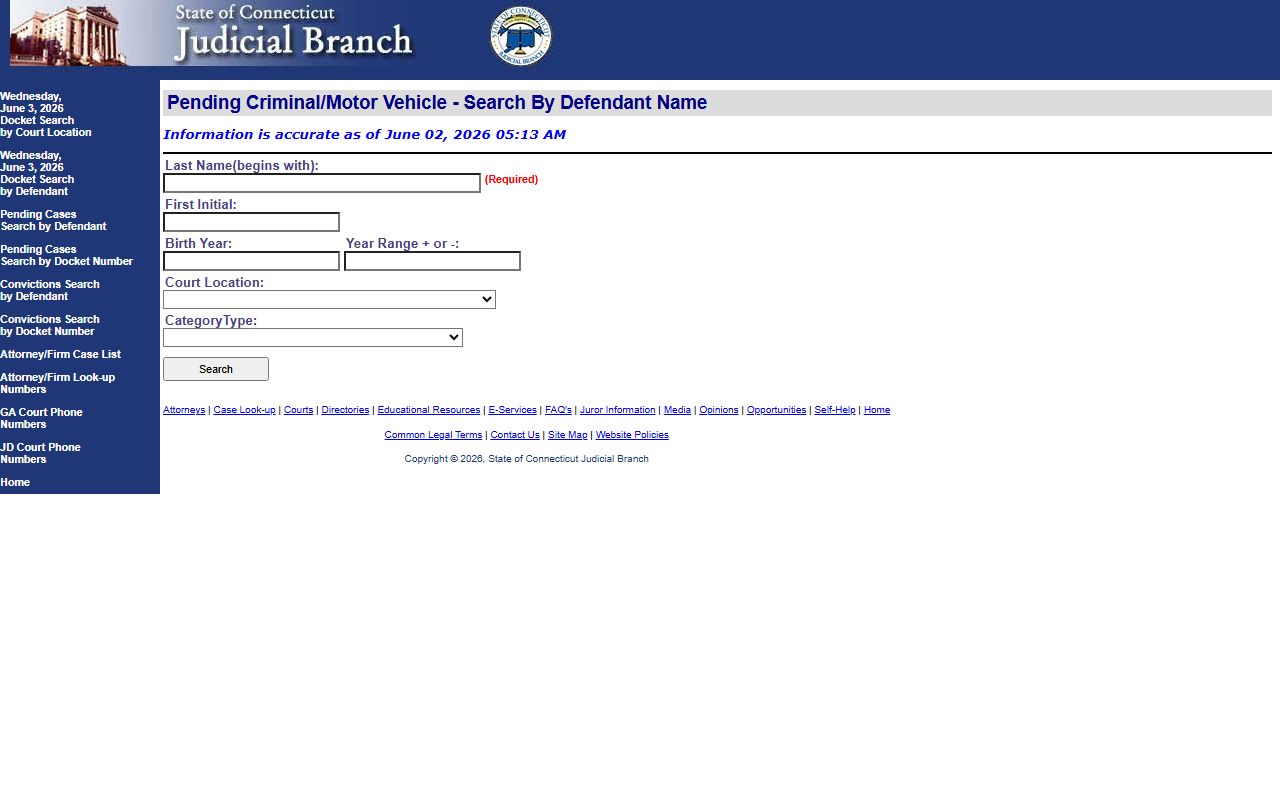
The Bridgeport court codes matter when you pick a location. F02B is Bridgeport Geographical Area 2, FBT is the Bridgeport Judicial District, and XBR is Bridgeport Housing. If you already have a docket number from police, an attorney, a bond receipt, or a court notice, the docket-number search is the most precise route.
Note: The pending-case tool shows only cases that have been entered and remain public, so a very new arrest may not appear at once.
Search Daily Dockets and Court Dates
The daily docket lists the cases set for a given court on a given day. It helps when you know someone has court soon or you want to scan a Bridgeport courthouse calendar. The Search by Court option asks only for a court location and a button. The Search by Defendant option asks for a last name. Both return the day's scheduled matters for that court.
The daily docket search by court is the tool for scanning a Bridgeport court date. The form is simple.
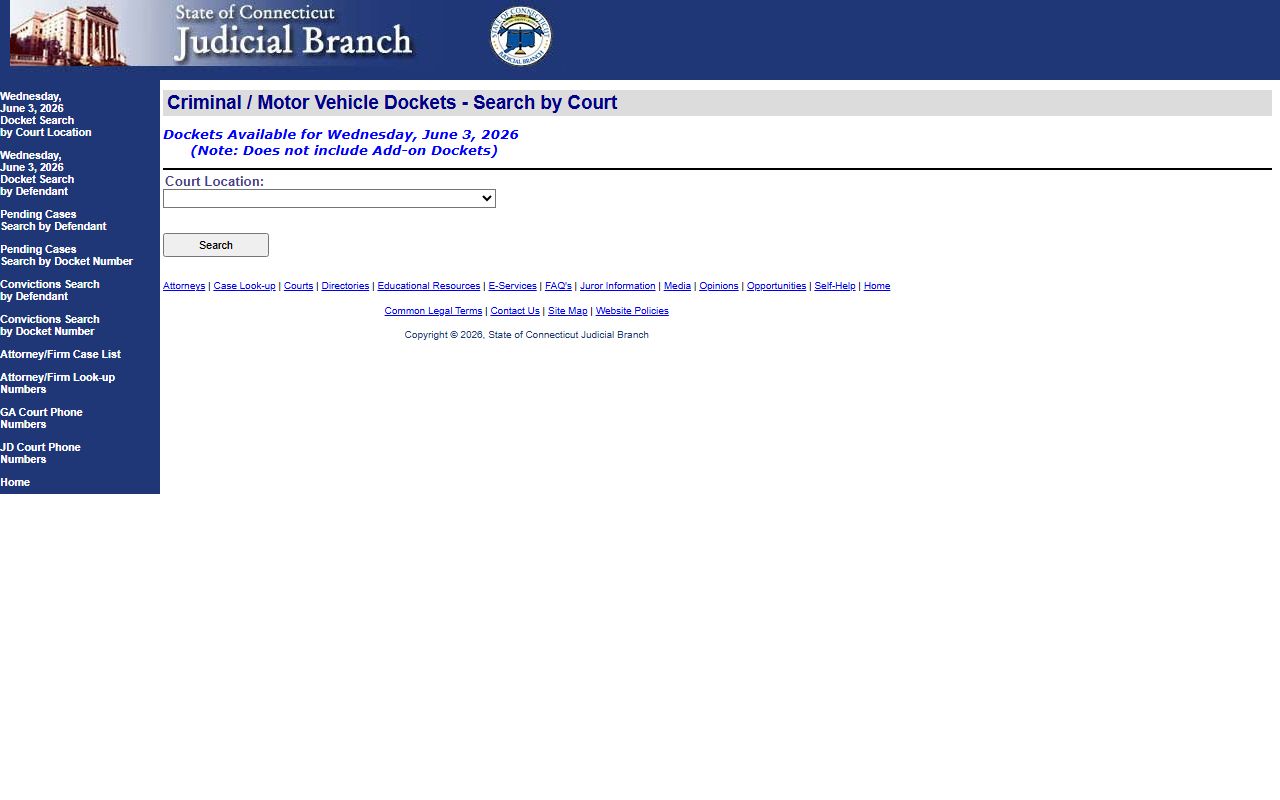
One limit is worth knowing. The official page warns that add-on dockets may not be included, so a case can be on the calendar without showing in the list. Previous-day dockets are also non-disclosable, while present and future criminal and motor vehicle dockets are open. For a case-specific question, the clerk's office where the case was filed is the fallback.
How Charges Get Filed After an Arrest: Complaint, Information, and Indictment
The court record begins when a charging document is filed. After booking at the jail, the matter goes to the prosecutor, who decides what to charge. Three document types appear across criminal courts. A complaint is the simplest and is common for lower-level matters. An information is filed by the prosecutor and is the workhorse for most charges. An indictment comes from a grand jury and is reserved for the most serious offenses.
| Complaint | Information | Indictment | |
|---|---|---|---|
| Filed By | Officer / Prosecutor | Prosecutor | Grand Jury |
| Common For | Misdemeanors | Many felonies | Serious felonies |
| Starts | The case | The case | The case |
Connecticut leans heavily on the first two. Most Connecticut criminal cases begin by information or complaint from the State's Attorney. Grand-jury indictments are rare in Connecticut state court. In Bridgeport, where a case lands depends on the charge level. Part A, the Judicial District office at 1061 Main Street, handles more serious cases, mostly class A or class B felonies. Part B, Geographical Area No. 2 at 172 Golden Hill Street, takes class C, D, and E felonies, all misdemeanors, infractions, and motor vehicle offenses.
Note: Because charges are filed by the prosecutor rather than fixed at arrest, the document that opens a case can list offenses that differ from the booking charges.
Charge Status and What It Means
Charges change as a case moves through court. A prosecutor or judge may amend, reduce, add, or drop charges. The booking charges on the jail roster can differ from the charges the State's Attorney finally files, so the court record is the better source. The terms below show up often in Connecticut case results. A few carry timing rules tied to public access.
| Status | What It Means |
|---|---|
| Pending | The case or charge is open and has not reached a final disposition. |
| Amended / Reduced | The prosecutor or court changed the charge; it can differ from the booking charge. |
| Dismissed | The charge ended without a conviction; files are available for 20 days after disposition unless appealed, then erasure rules close access. |
| Nolle Prosequi | The prosecutor declines to go forward; Connecticut records stay available for 13 months from the nolle entry, then erasure rules apply. |
A few more terms round out the picture. Disposed means the court entered a final outcome. An acquittal or not-guilty finding is a non-conviction, with records generally available for 20 days after disposition unless appealed. A conviction is a finding or admission of guilt, and the online conviction display is generally limited to about 10 years after sentencing. The word "nolle" simply means the state chose not to pursue the charge for now.
Bond and Release After an Arrest
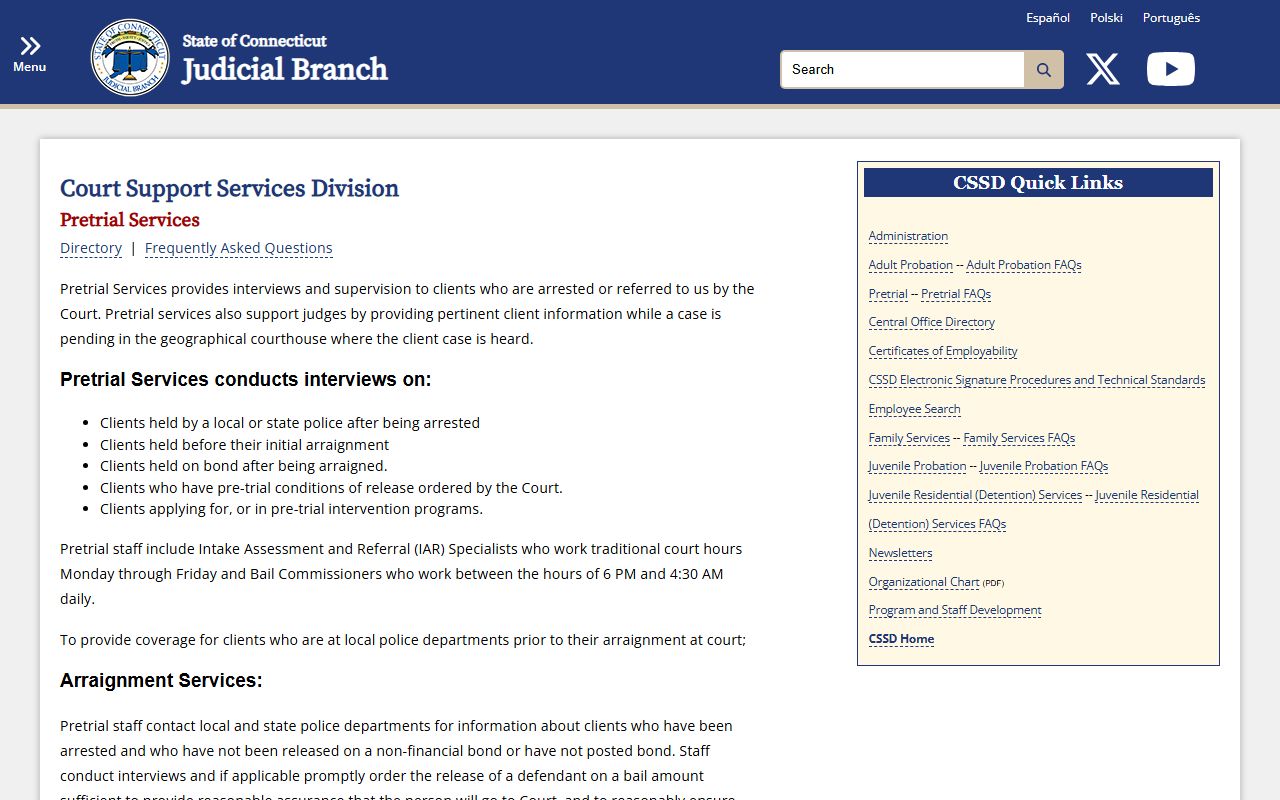
Bond is money or a promise that secures release while a case is pending. In Bridgeport, bail can be set in stages. Police may set bail at arrest. If the person cannot post it, police must notify bail staff, and Pretrial Services interviews the person and can raise or lower the police amount. A judge can set or change conditions in court. Bail may be posted at a police department, a courthouse, or a Department of Correction facility.
| Bond Type | How It Works |
|---|---|
| Cash Bond | The full bond amount is posted in cash. |
| Surety Bond | A licensed bondsperson posts the bond for a non-refundable fee. |
| PR / Promise to Appear | A nonfinancial release on a written promise to return to court. |
| No-Bond Hold | Release is blocked by extra warrants, a probation violation, detainers, or a federal or ICE hold. |
Since January 1, 2020, a 10 percent cash option is automatically available for bail set at $20,000 or less, including court and police bail, subject to listed exceptions. A "PR" or promise to appear means release with no money down, just a signed promise to come back. A "detainer" is a request from another agency to keep custody, and a probation violation, often shown as VOP, can stop a release. The Pretrial Services bail page explains the interview and release process.
A view of the Pretrial Services page shows where the bail and release rules are described.
Getting bond money back is a separate step. After the case is disposed or a diversionary program is granted, the depositor brings the receipt and a state-issued ID to the clerk's office at the court where the case was heard. A check is then issued to the depositor. Connecticut bail and release rules sit in Conn. Gen. Stat. Sec. 54-63b and 54-63d.
Warrants That Lead to an Arrest
An outstanding warrant can turn an ordinary stop into a booking. Connecticut offers one official public warrant search, but it covers only certain types. The Judicial Branch warrant search lists arrest warrants for violation of probation, failure to appear, and orders to incarcerate. You search by last name with at least two letters, and you can add a town or court location. The page warns plainly that it does not contain all warrant types and is informational only.
The warrant search form is short, and Bridgeport appears as a town and court option.
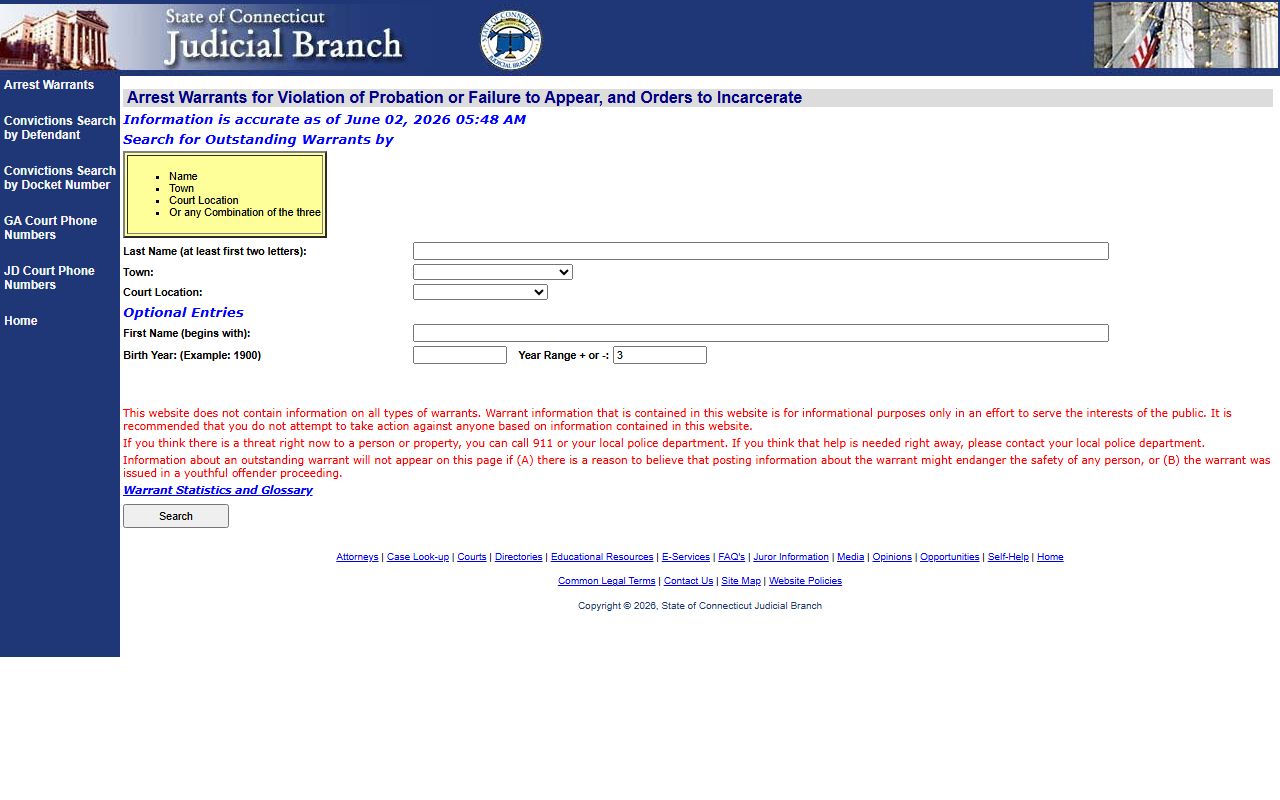
For other warrant types, there is no single public Bridgeport list. To start a warrant application, the Bridgeport Police Detective Bureau handles the process. The bureau is open Monday through Thursday from 9 a.m. to 4 p.m., and appointments use 203-581-5201. For a case already in court, the clerk's office is the better source. No official Bridgeport "most wanted" page was found in official records.
Charges vs. Convictions
Being arrested and charged is not the same as being convicted. A charge is an accusation. It rests on probable cause and starts the case. A conviction is the end result, reached only when guilt is proven beyond a reasonable doubt or admitted by a plea. Both are public records, but they sit at very different stages.
| Charge | Conviction | |
|---|---|---|
| Stage | Accusation | Verdict or plea |
| Burden of Proof | Probable cause | Beyond reasonable doubt |
| Public Record | Yes | Yes |
This gap matters when reading a court file. A pending charge means nothing has been decided. The Bridgeport Police arrest blotter itself warns that a listed arrestee is not guilty unless and until convicted. A court record may show a charge that was later dismissed, reduced, or nolled, so the final disposition is the part that tells the real outcome.
Sealed vs. Expunged Arrest Records in Connecticut
Connecticut does not use the word "expungement" the way some other states do. The Connecticut term is "erasure." Under Conn. Gen. Stat. Sec. 54-142a, after eligible dismissals, nolles, acquittals, or pardons, records are erased, and public agencies generally cannot disclose them. The comparison below adapts the usual "sealed vs expunged" idea to Connecticut, where erasure does much of the work that other states call expungement.
| Sealed | Expunged / Erased | |
|---|---|---|
| Visibility | Hidden from public | Treated as erased, generally not disclosed |
| Law Enforcement | Limited access | Very limited |
| Eligibility | Court closes the record from public access | Connecticut erasure treats eligible records as erased; generally disclosed only to the subject |
Erasure carries practical timing. A dismissed charge stays in the file for 20 days, then the clerk may not disclose or acknowledge it unless an appeal is filed. A nolle stays available for 13 months from the day it is entered. After those windows, the record falls under erasure and drops out of public view. Once a record is erased, public agencies generally may release it only to the subject under proof-of-identity rules.
Background Check Considerations
Court records are easy to read but easy to misread. A casual online lookup is not the same as a formal background check. The Connecticut conviction search is limited by design. It shows convictions for only about 10 years, leaves out youthful-offender, juvenile, and infraction cases, and can change daily as erasures and pardons take effect. A real criminal-history check runs through the Connecticut State Police or a court record search, not a public docket scan.
Important: This is a public reference resource, not a consumer reporting agency under the FCRA, and nothing here may be used for credit, employment, tenant, or insurance decisions.
Restricted Court Records After an Arrest in Bridgeport County
Not every record is open, even after an arrest. Connecticut closes several categories outright. Juvenile records are generally closed, with narrow exceptions. Youthful-offender information is sealed and private, though open to the offender. Sexual-assault victim names and addresses are redacted, and bail-interview records are closed under Conn. Gen. Stat. Sec. 54-63d(e). Previous-day dockets are non-disclosable, and sealed or erased records are withheld.
For records that are open, copies carry a fee. Court records and documents cost $1.00 per page, and administrative records cost $0.25 per page. A written record search goes to the geographical area court where the arrest occurred, and the request should include the name, date of birth, and, if known, the date of arrest or disposition. Connecticut's open-records framework sits in Conn. Gen. Stat. Sec. 1-210 and Sec. 1-215, which make arrest records public from the time of arrest, subject to these limits. The duty to present an arrested person promptly comes from Conn. Gen. Stat. Sec. 54-1f.